
Robots Stopping Every Ten Minutes on Aluminum Hulls
Aluminum shipyards now launch a new ferry every few weeks and offshore wind factories deliver transition pieces faster than cranes can load them. Every minute the MIG gun stands still costs real money in overhead and delayed launch dates. The race for higher productivity has turned aluminum MIG wire from a simple consumable into the deciding factor between profit and chaos. Aluminum Mig Wire Manufacturers who understand robot cells, pulse power sources, and twenty-four-hour shifts supply the only wire that keeps up with tomorrow's production targets.
The difference shows first in feeding. Modern robotic lines push wire-feed speed far beyond what manual welders ever attempted. Ordinary wire shaves against the liner, builds aluminum dust, and clogs contact tips every few hundred meters. High-productivity wire leaves the drawing die polished and coated with a lubricant that survives the entire spool. Robots weld entire sixty-meter hull sides without a single tip change.
Pulse MIG has become the standard for thin 5083 plate. Background current keeps heat low while peak current drives penetration. Most wires lose stability when pulse frequency climbs to match travel speed. Marine-grade high-productivity wire maintains droplet detachment exactly where the power source wants it. The bead stays flat, toes blend perfectly, and spatter disappears even at thirty meters per minute on deck panels.
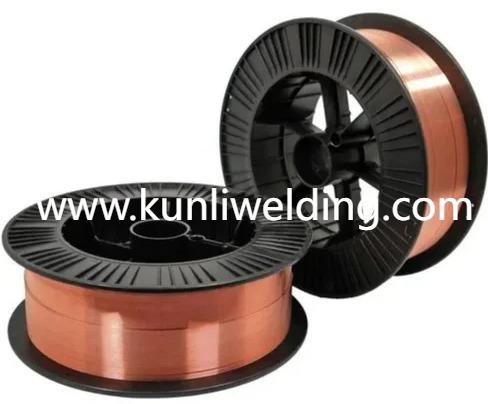
Large plastic spools eliminate the empty-spool surprise. Fifteen-kilogram baskets run out halfway through a long seam and force an emergency stop. High-capacity twenty-five or thirty-kilogram reels let robots finish multiple blocks on one spool. Precision layer winding keeps payoff tension constant from the first layer to the core so the arc never shortens or lengthens unexpectedly.
Surface cleanliness decides tip life. Aluminum oxide is abrasive. Wire that picks up dirt during coiling wears tips in minutes. High-productivity manufacturers clean the wire continuously during the final drawing pass and seal the spool immediately. Tips last entire shifts instead of entire hours.
Cast and helix control keep the wire loop perfect as it leaves the spool. Random-wound reels throw big loops that slap the liner and small loops that snag. Precision-wound reels maintain identical cast from start to finish. The torch never dances, seam tracking stays locked, and penetration stays uniform from corner to corner.
Diameter consistency removes another variable. A few hundredths too thick and the drive rolls slip. A few hundredths too thin and the wire burns back. High-productivity wire stays within tight tolerance every meter. Robots run fixed wire-feed speed without constant correction.
Push-pull guns on long conduit runs reveal the final advantage. Twenty-meter torch packages common on ferry blocks drag ordinary wire to a crawl. High-productivity wire glides through Teflon or nylon liners without resistance. Welders finish closure seams in one continuous pass instead of stopping to clear jams.
Yards building green methanol ferries and hydrogen patrol boats feel the pressure most. Launch schedules are fixed by government contracts and port openings. Every hour lost to feeding problems pushes the next vessel into overtime. Production managers now write wire specifications as carefully as they write robot programs.
Offshore module factories run three shifts welding transition pieces. One clogged tip at two in the morning means the whole night crew stands idle while someone hunts for spares. High-productivity wire eliminates that call. The same spool that started the day shift finishes the night shift without drama.
Manual welders on block assembly also benefit. Higher travel speed with lower spatter means each welder covers more meters per day. The bead looks robotic even when laid by hand. Foremen move crews faster and still pass visual inspection first time.
The pattern is universal: the moment production rate becomes the bottleneck, ordinary wire becomes the bottleneck. Aluminum Mig Wire Manufacturers who build for robot cells and pulse machines supply the wire that disappears into the feeder and lets the torch do what it was designed to do, weld fast and clean.
Teams chasing real productivity gains can see the proof at www.kunliwelding.com . Every ER5183 listing shows the precision spool, surface finish, and feeding videos taken from actual ferry hulls and offshore modules running at maximum speed. When the next high-output project demands aluminum MIG wire that keeps robots and welders moving hour after hour, the real-world performance waiting at kunliwelding.com shows exactly where yards and fabricators turn when stopping is not an option.

 English
 Arabic
 French
 Spanish
 Portuguese
 Deutsch
 Turkish
 Dutch
Dutch
 Russian
 Romaian
 Portuguese (Brazil)
 Greek
Greek